15 Mind-Blowing Science Experiments You Can Do at Home
10 minute read
#science experiments#DIY science#home experiments#educational activities#STEM activities#fun science#kids science#learning at home#scientific method#hands-on learning
Science isn't confined to sterile laboratories and expensive equipment. Some of the most mind-blowing scientific phenomena can be demonstrated right in your kitchen using everyday materials. These experiments transform boredom into wonder while teaching fundamental scientific principles.
Safety First
Before diving into experiments, remember these essential safety guidelines:
Always supervise children during experiments
Wear safety goggles when handling chemicals or creating reactions
Work in well-ventilated areas
Have water and towels readily available
Read all instructions completely before starting
Never taste or consume experimental materials unless explicitly stated they're food-safe
Dispose of materials properly according to local regulations
With safety established, let's explore fifteen experiments that will amaze and educate!
Chemistry Experiments
1. Elephant Toothpaste
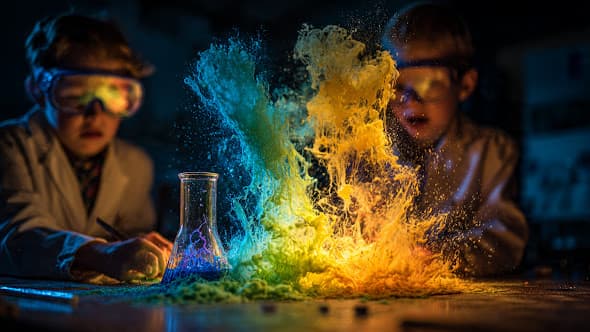
This spectacular foaming reaction creates massive eruptions of colorful foam, demonstrating exothermic reactions and catalysts.
Materials:
Hydrogen peroxide (6% or higher)
Dry yeast
Warm water
Dish soap
Food coloring
Large bottle or cylinder
Process: Mix warm water with yeast, let activate for 5 minutes. In the bottle, combine hydrogen peroxide, several drops of dish soap, and food coloring. Quickly pour the yeast mixture into the bottle and step back. Watch as foam erupts dramatically from the container.
Science: Yeast acts as a catalyst, breaking down hydrogen peroxide into water and oxygen. The soap traps oxygen bubbles, creating foam. The reaction releases heat (exothermic), which you can feel by carefully touching the bottle.
2. DIY Lava Lamp
Create mesmerizing dancing blobs without expensive lamps or electricity, demonstrating density and polarity.
Materials:
Clear bottle or jar
Vegetable oil
Water
Food coloring
Effervescent tablets (Alka-Seltzer)
Process: Fill the bottle 3/4 with vegetable oil. Fill the remainder with water, leaving space at the top. Add several drops of food coloring (which sinks through oil into water). Break effervescent tablets into pieces and drop them in one at a time.
Science: Oil and water don't mix due to different polarities and densities. Tablets create carbon dioxide bubbles that carry colored water through oil. When bubbles pop at the surface, water sinks again, creating the lava lamp effect.
3. Invisible Ink
Write secret messages using chemistry, demonstrating oxidation and pH indicators.
Materials:
Lemon juice or baking soda solution
Cotton swabs or small paintbrush
White paper
Heat source (lamp or iron)
Process: Dip swab in lemon juice and write your message on paper. Let dry completely (invisible). To reveal, carefully heat the paper by holding it near (not touching) a lightbulb or using a warm iron.
Science: Lemon juice oxidizes and turns brown when heated. The carbon compounds in juice weaken paper, which browns when heated before surrounding areas.
4. Color-Changing Cabbage
Create a natural pH indicator that changes color when mixed with different substances.
Materials:
Red cabbage
Water
Strainer
Various household liquids (vinegar, baking soda solution, lemon juice, soap, etc.)
Clear containers
Process: Boil chopped red cabbage in water for 10 minutes. Strain, keeping the purple liquid. Pour small amounts into different containers. Add various household substances and observe color changes.
Science: Red cabbage contains anthocyanin, a pH indicator. Acids turn it pink/red, bases turn it blue/green. This demonstrates pH scale visually.
5. Crystal Growing
Grow beautiful crystals overnight, demonstrating supersaturation and crystallization.
Materials:
Borax, sugar, or salt
Water
String or pipe cleaners
Pencil
Heat-safe container
Process: Create supersaturated solution by dissolving as much solute (borax/sugar/salt) as possible in very hot water. Suspend string or shaped pipe cleaner from pencil across container rim. Pour solution over string. Leave undisturbed overnight.
Science: As water evaporates and cools, the solution can't hold all the dissolved substance. Molecules arrange in orderly patterns (crystals) on the string surface.
Physics Experiments
6. Homemade Compass
Build a simple compass demonstrating magnetism and Earth's magnetic field.
Materials:
Sewing needle
Magnet
Cork or small piece of foam
Bowl of water
Process: Magnetize needle by stroking it 50 times in same direction with magnet. Pierce cork with needle or float needle on foam. Place in water bowl. The needle aligns north-south.
Science: Stroking aligns magnetic domains in needle. Earth's magnetic field causes the magnetized needle to orient along magnetic field lines.
7. Egg in a Bottle
Demonstrate air pressure by making an egg "jump" into a bottle.
Materials:
Hard-boiled, peeled egg (slightly larger than bottle opening)
Glass bottle with opening slightly smaller than egg
Matches or paper
Vegetable oil
Process: Rub oil around bottle rim. Light paper and drop into bottle. Quickly place egg on opening. Watch as egg gets sucked inside.
Science: Fire heats air inside bottle, causing expansion. When fire goes out, air cools and contracts, creating lower pressure inside. Higher external air pressure pushes egg into bottle.
8. Homemade Hovercraft
Create a working hovercraft using everyday materials, demonstrating friction reduction.
Materials:
Old CD
Balloon
Pop-top bottle cap
Hot glue gun
Process: Glue bottle cap over CD's center hole (closed position). Blow up balloon and attach to cap's top. Open cap and place on smooth surface. The CD hovers and glides with minimal friction.
Science: Air from balloon escapes through CD hole, creating cushion between CD and surface. This dramatically reduces friction, allowing smooth movement.
9. Magnetic Slime
Create slime that responds to magnets, combining chemistry and magnetism.
Materials:
White glue
Liquid starch
Iron oxide powder
Neodymium magnet
Process: Mix equal parts glue and starch. Add iron oxide powder and mix thoroughly. Play with slime near strong magnet.
Science: Iron oxide particles in slime respond to magnetic field, making slime move, form spikes, or seem to "eat" the magnet.
10. Water Density Tower
Stack different liquids in layers, demonstrating density differences.
Materials:
Honey
Corn syrup
Dish soap
Water (with food coloring)
Vegetable oil
Rubbing alcohol (with different food coloring)
Tall clear glass
Process: Slowly pour liquids into glass in order of density (honey, corn syrup, dish soap, water, oil, alcohol). Pour carefully down the side or over a spoon to prevent mixing.
Science: Different liquids have different densities (mass per volume). Denser liquids sink below less dense ones, creating distinct layers.
Biology and Nature Experiments
11. DIY Terrarium Ecosystem
Create a self-sustaining mini-ecosystem demonstrating the water cycle and plant biology.
Materials:
Clear jar with lid
Small pebbles
Activated charcoal
Potting soil
Small plants (moss, ferns, succulents)
Water
Process: Layer pebbles, charcoal, and soil in jar. Plant small plants. Add small amount of water. Seal jar. Place in indirect light.
Science: Plants photosynthesize, releasing oxygen and water vapor. Water condenses on jar sides and rains back down. The sealed system recycles materials indefinitely.
12. Extracting DNA from Strawberries
See actual DNA with the naked eye using simple kitchen materials.
Materials:
Strawberries
Ziplock bag
Dish soap
Salt
Water
Coffee filter
Rubbing alcohol (cold)
Process: Mash strawberry in bag. Mix 2 tsp dish soap, 1 tsp salt, 1/2 cup water. Add to strawberry and gently mix. Filter mixture through coffee filter. Slowly pour cold alcohol down side of container. DNA appears as white stringy substance.
Science: Soap breaks cell membranes, salt causes DNA proteins to separate, and alcohol makes DNA visible as it's not soluble in alcohol.
13. Seed Germination Observation
Watch plants grow from seed to sprout, understanding plant life cycles.
Materials:
Clear jar or plastic bag
Paper towel
Bean seeds
Water
Process: Dampen paper towel and line inside of clear container. Place seeds between towel and container sides (visible). Keep moist and in light. Observe daily changes.
Science: Observe root emergence, stem growth, and leaf development. Watch phototropism (growth toward light) and geotropism (roots growing down).
14. Fermentation Balloon
Demonstrate yeast fermentation and carbon dioxide production.
Materials:
Plastic bottle
Warm water
Sugar
Active dry yeast
Balloon
Process: Add warm water, sugar, and yeast to bottle. Immediately stretch balloon over bottle opening. Place in warm location. Balloon inflates over several hours.
Science: Yeast consumes sugar, producing carbon dioxide as byproduct. Gas inflates balloon. This same process makes bread rise and creates alcohol in brewing.
15. Osmosis Experiment with Eggs
Demonstrate cellular processes using eggs and common household liquids.
Materials:
Raw eggs
Vinegar
Corn syrup
Water
Clear containers
Process: Submerge egg in vinegar 24-48 hours (shell dissolves). Place naked egg in corn syrup for 24 hours (shrinks as water exits). Place shrunken egg in water 24 hours (swells as water enters).
Science: Vinegar dissolves calcium carbonate shell. The remaining membrane is semi-permeable. Osmosis causes water to move from high to low concentration areas, shrinking or swelling the egg.
Making Science a Habit
Document Your Experiments: Keep a science journal with observations, hypotheses, and results. This practices the scientific method and creates a record of your learning.
Ask Questions: Don't just follow instructions. Ask why each step works. What would happen if you changed variables? Science is about curiosity and inquiry.
Repeat and Vary: Try experiments multiple times with variations. Change one variable and observe effects. This develops critical thinking and understanding.
Share Your Discoveries: Teach others what you've learned. Explaining science to someone else deepens your own understanding.
Connect to Real World: Discuss how these principles apply to everyday life, technology, and nature. This makes abstract concepts concrete and relevant.
The Value of Hands-On Science
Reading about science informs, but doing science transforms understanding. These experiments turn theoretical concepts into tangible experiences, making abstract principles concrete and memorable.
Beyond the specific scientific knowledge, hands-on experimentation develops:
Critical thinking and problem-solving skills
Patience and careful observation
Understanding of cause and effect
Appreciation for scientific method
Curiosity about the natural world
Expanding Your Science Journey
These fifteen experiments are just the beginning. Once you've mastered these, countless resources provide additional experiments:
Science websites and YouTube channels offer thousands of demonstrations
Library books on home experiments provide detailed instructions
Science museums often have experiment guides
Online communities share creative variations
The world is full of scientific phenomena waiting to be explored. Every question about how things work is an invitation to investigate.
Conclusion
Science experiments transform boredom into discovery. They prove that learning doesn't require expensive equipment or professional facilities—just curiosity and willingness to explore.
These fifteen experiments demonstrate fundamental principles in chemistry, physics, and biology using materials you already have. They're perfect for rainy afternoons, educational family time, or personal learning adventures.
The next time boredom strikes, don't reach for your phone. Reach for simple materials and create something amazing. Watch invisible ink appear, grow crystals overnight, or make an egg jump into a bottle.
Science isn't about memorizing facts—it's about asking questions, testing ideas, and discovering how the world works. These experiments make you a scientist, and your home becomes your laboratory.
What will you discover first?
Disclaimer:
This article is meant for general information and entertainment purposes only. It does not replace professional advice of any kind. We always recommend using your own judgment and, if needed, consulting a qualified professional before making any decisions based on the content you read here. borebreak.com is not responsible for how this information is used.
Written by: Borebreak Team
More Articles
Check out our other articles to discover more ways to break boredom and stay engaged.